Why So Many of Us Are Crying in Yoga Right Now
Why crying in a yoga class taught me something about what people really need from yoga right now.
Reading time: 3 minutes
Let me set the scene.
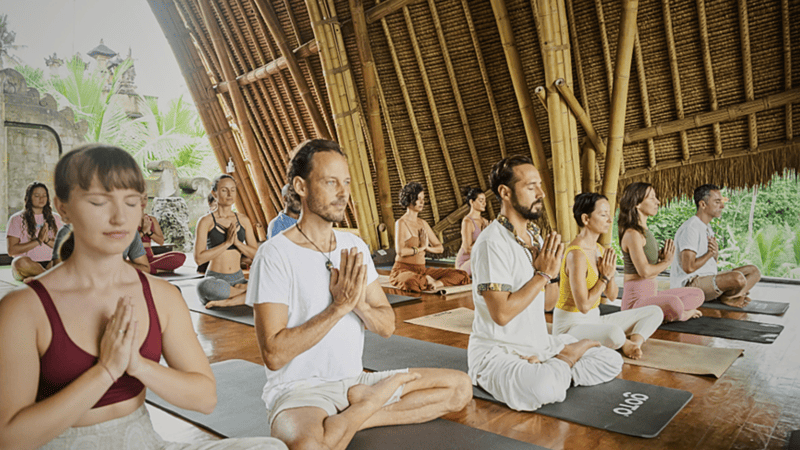
A few years ago, I was at The Yoga Barn in Bali, on a hot, sweaty, and humid morning for a 90-minute power flow. The teacher brought lightness and a sense of fun that I hadn't expected. He mixed self-forgiveness with challenge in a way I hadn't experienced before. At one point, he said, "By the way, doing this arm balance won't make you any more spiritual." This resonated deeply with me, as this is something I tell my students in classes and on retreats.
After all that intensity, we were coming in to land.
Shoulder stand, plow, fish. And then we arrived; Savasana.
My body was tired. My mind was tired. I was ready. I noticed the music first. Beautiful guitar. And then it dawned on me, it was live. The teacher was playing for us.
That was the moment the waterworks started.
Not quietly. Not politely. The full thing.
All the tension I'd held through class, releasing with every sob. Shoulders dropping. Chest softening. Jaw loosening. I allowed myself to feel fully, to let go, to be completely vulnerable on a mat surrounded by strangers.
And, guess what, it felt amazing.
This wasn't new, but it felt different. I've cried in Savasana before. In my early years of practice, it happened a lot. But those tears came from a different place. Loss, mostly. Sadness. The kind of grief that your body holds onto while you get on with the busyness of life.
This felt different. This was gratitude. Relief. The joy of being completely present. I am here, and I am alive.
I've been thinking about that experience a lot recently, not just as something that happened to me once upon a time in Bali, but as something that seems to be happening everywhere. In studios. On retreats. In classes I teach myself. Something has shifted in what people bring onto the mat, and what they're looking for when they get there.
What People Are Arriving With Has Changed
I've been teaching for long enough now to notice a pattern. People used to come to yoga for the physical stuff, a bit of movement after a long desk day, with some added de-stressing. The emotional release, when it came, was a surprise. Something that happened quietly in the corner and would be quickly forgotten.
Now? People are arriving already knowing that's what they need. They're not embarrassed. They don't apologise for their tears. They're asking for it. "I just need somewhere to breathe". "I've been numb for months." "I don't know why I'm here, but my friend told me I needed to try."
I recently read a report from BookRetreats.com that stated mentions of "crying" in retreat reviews is up 533% since 2018, and the phrase "safe space" has increased ten times. That's not a blip. That's something fundamental changing in what people are looking for when they step onto a mat or book a retreat away. The research also found that more than half of people seeking a yoga retreat now say improving their mental health is the main reason they go. Not flexibility, not fitness, not even relaxation in the traditional sense.
Some might see this as a bleak picture of the world right now, but I don’t. I find it honest and oddly comforting. I already saw what was quietly happening in the back of class five years ago and felt it myself. It’s just that now, more people are walking in for the same reason, knowing that yoga is a place they can finally let go.
What I've Had To (Un)learn As A Teacher
My passion as a yoga teacher is alignment and anatomy. I trained to understand the body's mechanics: how it moves, where it compensates, and how to cue someone to find a pose that works best for their body. What I've learned since then is that emotional holding and physical holding are often the same conversation.
...A clenched jaw.
...A shoulder that won't soften no matter how many times you cue 'relax.'
...A hip that locks up in the poses that are supposed to open it.
The body remembers what the mind has been too busy to process. And sometimes, on a mat, with enough stillness, it gets permission to let it go.
That's changed how I teach. I slow down more. I give poses time. I've learned that silence isn't something to fill; it's actually the point.
I've also had to get comfortable with what happens when someone cries in class. You learn to keep holding the space. You don't rush to fix it. You don't make it weird.
The teacher in Bali didn't break off to check on me. He kept playing. And that was exactly what I needed.
No Moral. Just This.
After class, I didn't explain myself to anyone. I rolled up my mat, thanked the teacher, and walked out into the Ubud heat feeling lighter than I had in months.
There's no grand message here. Your experience isn't mine, and mine isn't yours. Crying in Savasana or any pose isn't the goal of yoga, and, to quote that teacher, "it doesn't make you more spiritual."
But I do think there's something worth saying about what's happening in yoga rooms right now. People are arriving more burdened, more depleted, more in need of somewhere that feels safe.
And they're finding it. On a mat, in a studio, on retreat, somewhere that lets them feel fully, without apology.
If you, too, are feeling the weight of the world right now, or seeing a heaviness in your students, remember that this is exactly why we have yoga. Not to get the perfect pose or right cue, but for the exhale that comes after.

Hannah Saunders
Hannah Saunders is a yoga teacher and retreat host based in Portugal. She teaches alignment-based yoga with a focus on the nervous system and runs retreats in Madeira