
Co-Regulation on the Mat: 5 Mother–Baby Yoga Therapy Practices
Although a baby has been born, the relationship itself is still emerging. Mother and baby continue to learn one another’s cues, rhythms and needs. Their nervous systems remain deeply interconnected.
Reading time: 3 minutes
When I began working with postpartum mothers as part of my yoga therapy training, I expected my focus to rest primarily on the women in front of me.
Instead, I became fascinated by the space between mother and baby.
Again and again, I noticed something remarkable. When a mother’s breath softened, her baby’s body often softened too. When she felt calmer, more grounded and supported, her baby seemed to settle alongside her. It was as though they were sharing an invisible conversation, existing beyond words.
Modern neuroscience offers language for this through concepts such as co-regulation and nervous-system attunement. Yoga, however, has always understood something similar: we do not exist in isolation. We affect one another through our breath, presence and attention.
This is especially true in early motherhood. Although a baby has been born, the relationship itself is still emerging. Mother and baby continue to learn one another’s cues, rhythms and needs. Their nervous systems remain deeply interconnected.
In a recent group yoga therapy, I worked alongside a small group of mothers navigating the realities of postpartum life: overwhelm, anxiety, hypervigilance, guilt, exhaustion and the relentless feeling of being needed. What struck me was not the complexity of the practices we explored but their simplicity. Slower breaths, gentle sways, a conscious pause. Over time, these small practices seemed to create meaningful shifts. Mothers reported feeling calmer, more confident and better able to cope with the challenges of early parenthood. Many described feeling more connected to both themselves and their babies.
The practices that resonated most were not elaborate routines. They were simple rituals that could be woven into everyday life. Here are five of my favourites.
1. Heart-to-Heart Breathing
One of the most powerful places to begin is with simple contact.
Sit comfortably or recline with your baby resting safely against your chest. Place one hand over your own heart and allow your other hand to rest gently on your baby’s back.
As you inhale through your nose, notice the rise of your chest beneath your baby. As you exhale, allow your shoulders to soften and your jaw to release. There is no need to force the breath or strive for a particular technique. Simply allow your exhalation to become a little longer and softer.
Babies are exquisitely sensitive to rhythm. They feel our breathing patterns, our muscle tension and the pace of our movements. When we soften, they often respond in kind. Remain here for a few minutes and simply enjoy being together.
2. Rocking Cat-Cow
Many mothers instinctively rock their babies. Yoga offers us a way to bring awareness to that natural movement.
Come onto hands and knees with your baby safely positioned on a blanket in front of you. As you inhale, gently lift through the chest and lengthen the spine. As you exhale, round through the back and soften the head towards the heart. Move slowly and allow the breath to guide the rhythm.
This gentle variation of Cat-Cow mobilises the spine, eases tension through the shoulders and upper back, and invites the nervous system to shift into a more regulated state. If your baby is alert, allow them to watch your face as you move. The shared eye contact can become part of the practice itself.
3. Infant Massage as Mindful Touch
As a Certified Infant Massage Instructor, I have seen first-hand how powerful simple touch can be. Infant massage is often discussed in terms of supporting digestion, sleep or physical comfort, yet what continues to move me is the quality of connection it creates.
Choose a quiet moment when your baby is calm and receptive. Using a small amount of suitable oil if desired, begin with gentle strokes along the legs, feet or tummy. Rather than focusing on technique, focus on presence. Notice your baby’s expressions. Notice your own breath. Notice the subtle conversation taking place through touch.
Many mothers in our cohort described these moments as unexpectedly regulating for themselves. In slowing down enough to meet their baby, they often found themselves returning home to their own bodies as well.
4. Bhramari (Humming Bee Breath)
Long before babies understand language, they understand vibration. Bhramari, or Humming Bee Breath, is one of yoga’s simplest and most soothing breathing practices.
While holding, feeding or sitting beside your baby, inhale gently through the nose. As you exhale, create a soft humming sound, allowing the vibration to resonate through your chest, throat and face. Feel the exhalation lengthen naturally.
Many babies appear soothed by the vibration and rhythm of the sound. Mothers often report feeling calmer too.
In yoga, sound has long been recognised as a powerful tool for regulating the nervous system. We need not chant elaborate mantras. Sometimes a simple hum is enough.
5. Constructive Rest
Motherhood asks a great deal of the body. Feeding, carrying, lifting and responding can leave mothers feeling physically depleted and emotionally overstretched. One of the most popular practices in our programme was also one of the simplest.
Lie comfortably on your back with your knees bent and feet resting on the floor. Allow the knees to gently fall towards one another if that feels comfortable. Place a folded blanket beneath your head if needed. There is nothing to achieve here.
Simply rest.
Feel the support of the ground beneath you. Allow your breath to move naturally. Notice where your body is gripping and gently invite those areas to soften. For many mothers, this position offers something they rarely experience during the day: being supported.
The mothers I worked with were not looking for perfection but steadiness. For a way to meet the intensity of motherhood without losing themselves within it. These small moments of awareness created meaningful change, softer breath and moments of stillness shared between mothers and their babies. Research increasingly suggests that when parents cultivate mindful regulation like this, their infants benefit too. Perhaps many know this, intuitively.

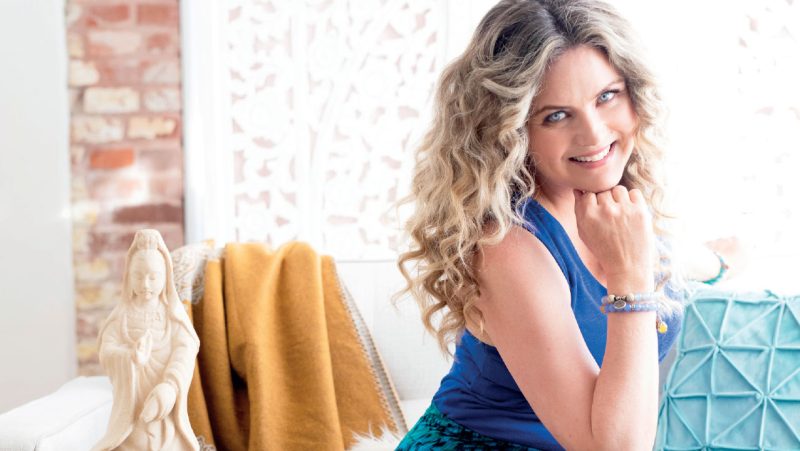
Tara Whyte
Yoga therapist-in-training, writer and mother exploring matrescence, nervous-system regulation, birth memory and co-regulation through yoga, sound and sacred stories.