
Sponsored Article
A Simple Evening Yoga Routine to Help You Sleep Better
A good deep sleep is all you need after a hectic week. Check out how evening yoga can shape your sleeping routine.
If you've ever lain in bed with a busy mind and an aching back, wondering why sleep won't come, a short evening yoga routine might be the simplest fix you haven't tried. You don't need to be flexible, you don't need an hour, and you certainly don't need to be good at it. Just ten or fifteen quiet minutes of gentle stretching before bed can genuinely change how quickly you drift off to sleep. Here's a straightforward routine and, just as importantly, how to make it work.
Why Evening Yoga Helps You Sleep
It's worth understanding why this helps, because it isn't just a nice idea. Gentle, slow movement releases the physical tension that builds up through a day of sitting, standing, and carrying stress in your shoulders.
The slow breathing that comes with it nudges your nervous system out of alert mode and into rest mode. That combination is exactly the state you need to fall asleep. Evening yoga is simply a practical way of getting there.
Keep It Gentle
Keep it gentle because this is the part most people get wrong. Evening yoga is not the time for anything strenuous, sweaty, or ambitious. A vigorous late-night session raises your heart rate and body temperature, which can leave you feeling more energized than when you started. Think slow, soft, and restorative instead. Hold poses for a while, breathe deeply, and avoid rushing from one movement to the next. If it feels like hard work, you've probably chosen the wrong practice for this time of day.
Start With a Few Minutes of Breathing
Start with a few minutes of simple seated breathing. Sit comfortably, either cross-legged or on a cushion. Let your shoulders drop, close your eyes, and breathe slowly in and out through your nose, making each exhale slightly longer than each inhale. Stay here for two or three minutes. It may feel almost too simple to make a difference, but this is the part that begins shifting your nervous system towards rest and sets the tone for everything that follows. Don't skip it in a rush to get to the stretching.
A Gentle Forward Fold
Move into a gentle forward fold, either seated with your legs out in front of you or standing with your knees softly bent. Let your head hang naturally, don't force anything, and allow gravity to do the work while you continue breathing slowly. Forward folds are wonderfully calming. They release tension through the back of your body while encouraging a peaceful, inward focus. Hold the pose for about a minute, letting yourself soften a little more with each exhale rather than pushing to reach further.
A Soft Spinal Twist
Follow that with a gentle spinal twist, which is especially helpful if you spend much of your day sitting at a desk. Lie on your back, draw your knees towards your chest, and let them fall gently to one side while turning your head in the opposite direction. Keep both shoulders as close to the floor as feels comfortable. Stay there for about a minute before repeating on the other side. Twists ease tightness through the spine and ribcage, and there's something about them that feels like physically wringing out the day's tension.
Legs Up the Wall
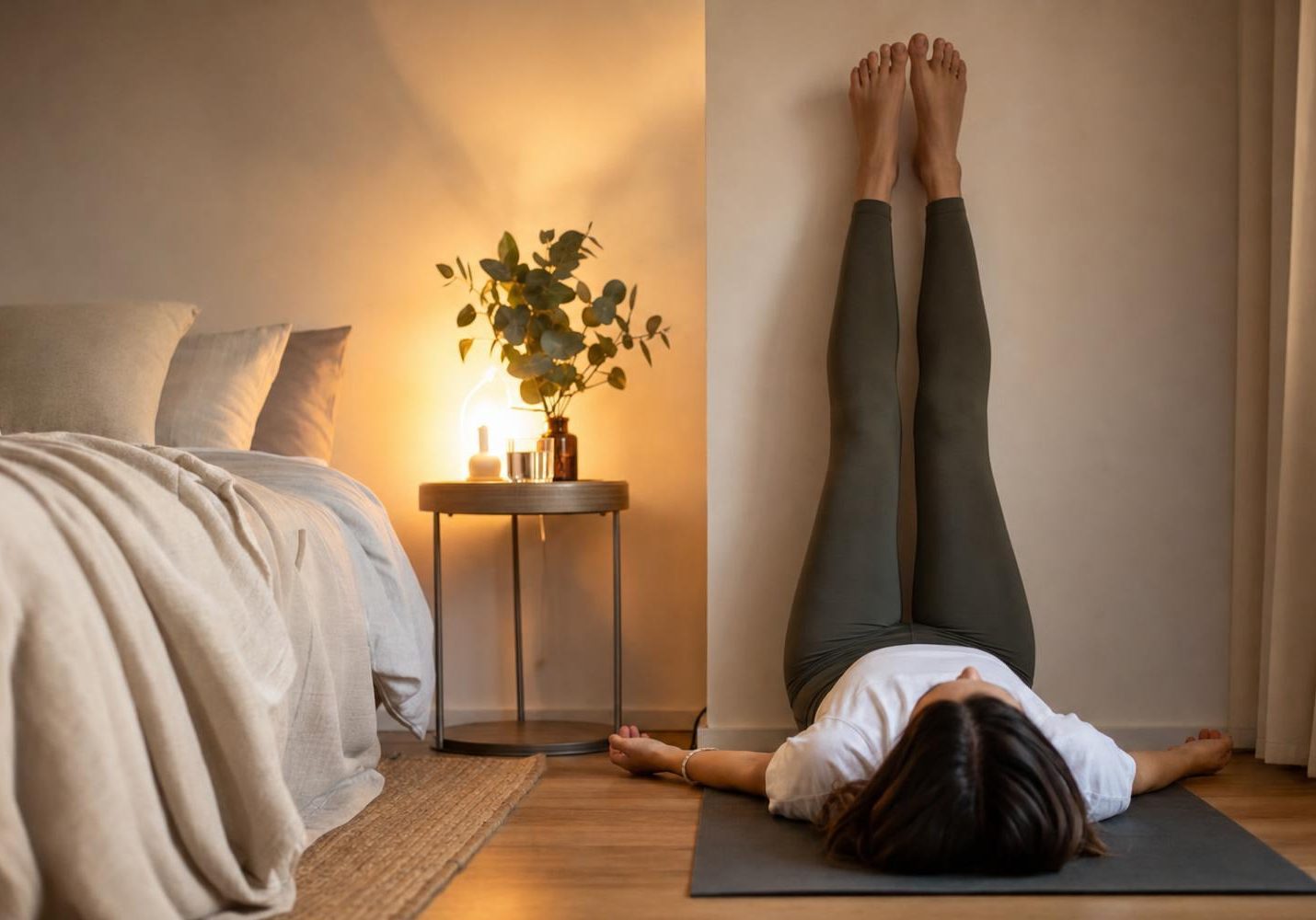
Finish with Legs Up the Wall, one of yoga's most relaxing poses. Lie on your back with your hips close to a wall and your legs resting straight up against it. Let your arms rest comfortably by your sides and stay there for five minutes. It's deeply restful, helps relieve tired legs, and leaves most people feeling noticeably calmer. If using a wall isn't practical, resting your lower legs on the seat of a chair offers a very similar effect with even less effort.
Set Up Your Space
Where you practice matters more than you might think.
You don't need a studio or even a yoga mat. A little floor space, a folded blanket, and enough room to lie down comfortably will do. Keep the lights low, place your phone in another room or well out of reach, and create an environment that feels calm rather than functional. The goal is to signal to your body that the day is winding down, and a quiet, dimly lit space does that far better than a brightly lit kitchen floor.
Some Poses Work Best in Bed
Some of the most relaxing poses can even be done in bed, where comfort and support become especially important. A gentle twist, a knees-to-chest hug, or a few slow breaths while lying flat all work beautifully as the final step before sleep.
However, this is possible only if your mattress supports you properly instead of sagging in the middle. If your mattress has seen better days, something like a mattress topper for gentle overnight support can make a noticeable difference, creating a more comfortable surface for stretching and settling into sleep.
Let the Breath Lead
Let your breath guide every movement throughout the routine. It's tempting to think of yoga as simply a series of poses, but the breathing is what creates most of the calming effect. Breathe slowly through your nose, make each exhale a little longer, and let every breath out be an opportunity to soften into the pose you're holding. If your mind drifts towards tomorrow's to-do list, notice it and gently return your attention to your breathing.
Be Consistent, Not Ambitious
Focus on consistency rather than ambition because a short routine you complete every evening is far more effective than a long one you only manage occasionally. Ten minutes is more than enough. Doing it at roughly the same time each night turns it into a cue your body begins to recognize, so before long, even those first few slow breaths can make you feel sleepy. Think of it as part of your evening wind-down rather than another workout, and it becomes something you'll actually look forward to.
Ten Quiet Minutes
A simple evening yoga routine is one of the easiest and most affordable sleep aids available, and it asks very little of you. Keep it gentle, breathe slowly, fold forward, twist gently, put your legs up the wall, and create a calm, comfortable space. Do that most nights and you'll likely find yourself getting into bed with a more relaxed body and a quieter mind.
This is often all you need to fall asleep. No flexibility, no equipment, and no expertise required! All you need is ten quiet minutes for yourself.

Om Magazine
First published in November 2009, OM Yoga magazine has become the most popular yoga title in the UK. Available from all major supermarkets, independents and newsstands across the UK. Also available on all digital platforms.