My Story - Maggie Toole's Yoga Journey
Charting a path from serious illness and hidden addiction to recovery: Maggie Toole explains in her own words the role yoga played in helping her reconnect with her body and rediscover a sense of purpose by supporting others
It all started with a vibration on my wrist. A normal day in June 2024, my smartwatch suddenly sounded an alarm. AFib — atrial fibrillation — flashed across the display. I had no idea what that meant. I stood there, holding my wrist, trying to understand what my own heart was telling me. I tried Google. Your heart is beating erratically.
Ah, okay. It was stiflingly hot for Scotland, and I had just finished a tiring CrossFit session. I was recovering. No issues, I thought.
Two days later, I was in hospital with a heart rate of 220 beats per minute. The doctors were not calm. I began to understand that this was serious; definitely more serious than I had allowed myself to believe. A few tense days in hospital followed until they could bring my heart rate down.
But the AFib wasn’t controlled. It didn’t stop. And for the next three months, I was seriously ill.
I was housebound. Even walking around the house was a struggle. I was completely dependent on medication just to get through each day — and medication that wasn’t even fully doing its job. More than anything, I relied on my wonderful husband to take care of me.
Eventually, a cardiac nurse saw me, reviewed my medication, and made some changes. Thankfully, that made all the difference. Slowly, I began to feel like myself again — more alive, more present and slightly more hopeful.
The moment of truth
I slowly realised that the career I had given so much of myself to — the high pressure, the stress, the kind that asks everything of you — was over. I retired early, not really by choice but by necessity.
And lying there, in the strange suspended stillness of illness, I faced a truth I had been avoiding for years: If I did not change, I would not be here.
Here is the part people don’t always expect. The thing I needed to confront wasn’t alcohol. It wasn’t anything that carries the obvious labels we reach for. It was sugar.
Years of my high-stress career had left me with sugar as my constant companion. It was my reward, my release, my way of coping when the pressure became too much. It is quieter than other addictions. Easier to hide — even from yourself. But sitting with the honest weight of hindsight — and the actual bodily weight it had caused — I believe it contributed directly to my heart condition.
The body keeps the score, even when the mind looks away. That was the thing I had to say out loud. To myself, and eventually to someone else.
“Recovery brought me to the NHS exercise referral programme. It was a lifeline: access to community fitness classes at a time when I needed movement but had almost none left in me.”
A lifeline back to movement
Recovery brought me to the NHS exercise referral programme. It was a lifeline: access to community fitness classes at a time when I needed movement but had almost none left in me. I have always loved yoga and had practiced it for years. For now, chair yoga felt like something I could actually do. Gently, tentatively, I started moving again. And it helped. Small things began to shift.
Then came the day that changed everything, though I didn’t know it at the time. My regular yoga teacher was on holiday, and a new teacher, Rachel, was covering the class. From the moment she introduced herself, I felt something different in the room, a quality of attention, a presence I couldn’t quite name.
She wasn’t just a yoga teacher. She was also a yoga therapist and worked with people navigating addiction. At the end of that class, I knew I had to connect with her. I asked her a question I had never managed to ask anyone before: could she help with food addiction, specifically sugar? She didn’t flinch. She didn’t hesitate. She simply said yes. The relief of that moment was difficult to describe. It was like setting down a heavy burden I had been carrying alone for a very long time.
Learning to feel
We began working together in yoga therapy. I admit, I didn’t know what to expect. I think I assumed it would feel like physical therapy; someone assessing what was broken and making a plan to fix it.
But Rachel didn’t operate that way. The sessions were quiet. Unhurried. She would ask me how I was feeling in my body. And I would pause, genuinely uncertain. Because for so long, feeling had been the thing I was trying to outrun.
That’s what addiction does, or at least what it did to me. It creates an efficient system of avoidance. Not just of pain, but of everything. A restlessness. A low hum of shame that had no clear origin, just lived somewhere in my head. I had learned to move through my days in a managed numbness, performing the version of myself that other people knew.
Inside, there was fog. And under the fog, something I could not name, something I had decided, somewhere along the way, was too painful to face.
Rachel saw through all of it without making me feel exposed. She would notice small things — the way I held my breath when I moved into something unfamiliar, the way my shoulders climbed toward my ears before I even registered I was bracing.
She’d say something quiet and precise, and I’d feel it land somewhere true. She had a way of reflecting back a version of me that wasn’t reduced to my history — a version that had capacity, that had range, that wasn’t defined by the years I’d lost myself.
A shift, not a breakthrough
I didn’t trust yoga as a healer at first. When you’ve spent a lifetime building an identity around your own limitations, someone else’s belief in you can feel like a threat. But she was patient, in a way that didn’t feel like patience. It felt like fact. Like she simply knew something I hadn’t caught up to yet.
In the sessions, we worked slowly. Talking. Releasing more than I can name. Chair yoga, seated stretches, breathwork, meditation, yoga nidra. Small movements I might once have dismissed as ‘not enough’.
But in that room, nothing felt small. I remember the first time I really exhaled — not just breathed out, but let go — and felt something shift. Not a breakthrough exactly. More like a crack in something that had been sealed shut for a long time. Once, during a simple chest-opening movement, I felt suddenly emotional. I almost cried (I don’t cry, but that’s another story!). Rachel didn’t make it strange. She simply said: “That happens.” I became hooked; not in the way of compulsion or escape, but in the way of coming home. A discipline that felt like joy. A practice that asked something of me and gave back more than I put in. Those three weeks opened a door I hadn’t known was there.
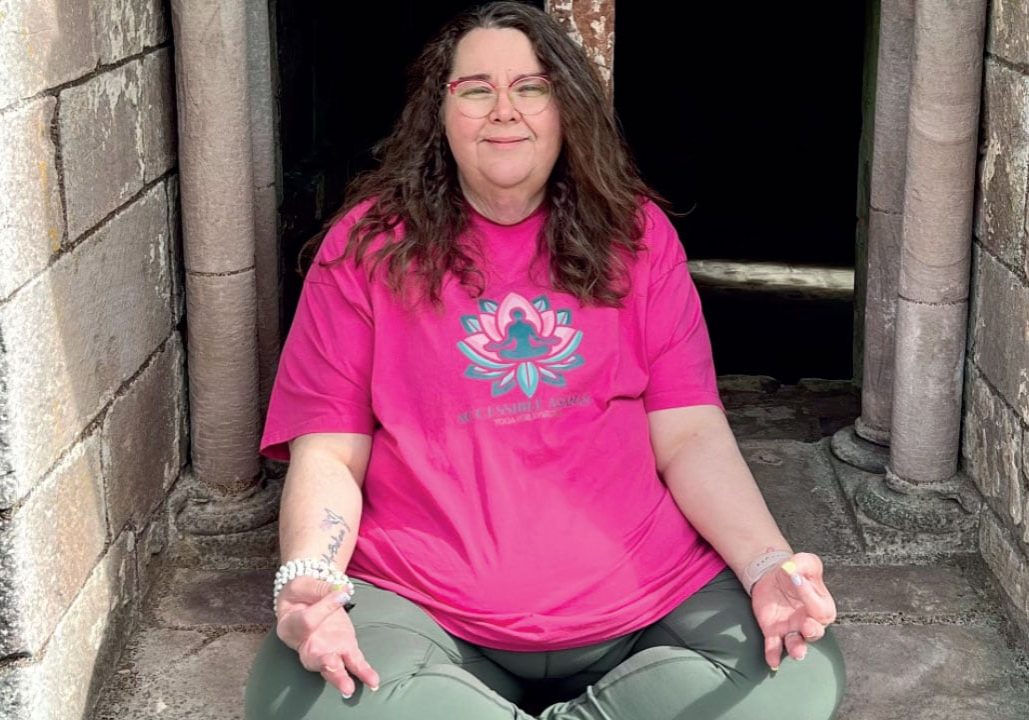
Accessible Asanas
I needed to understand yoga more deeply: its philosophy, its ethos, what sits beneath the postures and the breath. So I registered for an online teacher training course. During this time, Rachel and I continued working together on the practical side. And before long, to my own quiet astonishment, I had passed — with distinction. I was a yoga teacher!
I sat with that for a while. And then I began asking a different question: What if I could use this — and my story — to help others facing their own challenges? What about the people who had been turned away, overlooked, made to feel yoga was not for them? People like me.
By this point, I had lost five and a half stone. Yoga was working; genuinely, measurably, transformatively working. And I wanted to share that.
Accessible yoga — yoga for everyone, regardless of size, age, or circumstance — was born in my mind on an ordinary afternoon. And once it arrived, I couldn’t let it go.
Living in the Scottish Borders brought unexpected good fortune. I discovered the South of Scotland Pathways Programme, designed to help underrepresented individuals bring business ideas to life. I applied, not entirely sure I believed it would work. I was accepted.
The programme gave me a business mentor, Sian, whose guidance proved invaluable. Like Rachel, she had more confidence in my idea than I did — and her enthusiasm was infectious. It also gave me a grant. But more than that, it gave me conviction, that this was real. That it was possible. Two months later, Accessible Asanas was born.
Still on the Journey
I am now a yoga teacher whose practice quite literally saved my life.
From a hospital bed with a heart rate of 220, to standing in front of a class watching people move, breathe and feel more at home in their bodies, the distance between those two moments is real. And yoga is what connects them.
My weight loss has now reached seven stone. I am still on my journey — I expect I always will be — but the direction is clear.
Today, I run yoga classes online and in person. People come back each week with their own histories, their own hesitations, their own reasons for feeling like yoga might not be for them. And we all practice together.
Looking back, Accessible Asanas exists because of a watch alarm. A hospitalisation. Three months of stillness that turned out not to be empty. A teacher who said ‘yes’ without hesitation. Twenty-one early mornings. A course. A mentor. A grant. And every person who has ever felt they didn’t belong in a yoga class. Because they do.
Find out more about Accessible Asanas and connect with Maggie Toole on Instagram @accessible.asanas
From there, his teacher, Claire, introduced him to Upward Frog’s studio on Chestergate and he’s been going there ever since. By later on that year he was off all medication entirely, and has not been on any for pain since, not one paracetamol — and that’s six years since first walking into the yoga class.

Om Magazine
First published in November 2009, OM Yoga magazine has become the most popular yoga title in the UK. Available from all major supermarkets, independents and newsstands across the UK. Also available on all digital platforms.