A Short Case for Silliness in a Serious World
I’m done with adulting. If anyone wants me, I’ll be colouring, in my blanket fort.
Reading time: 3 minutes
Ratios are important in life for many reasons. Imagine a quiche or a pizza with too much base and too little topping. Sandwiches are similar that way. What about resting poses vs standing poses?
The Pareto Principle of 80:20 applies to many things, where 20% of the effort drives 80% of the results.
What about confidence and the humility of a beginner’s mindset? Healthy and less healthy diet choices are always up for adjustment (I find); it’s all about balance and blend. It doesn’t need to be 50/50, but it needs to be right for you.
So what about adulting and silliness?
I heard a podcast recently which highlighted this point. After running an improv workshop, the podcaster was approached by a participant who thanked him for bringing some pockets of joy to the seriousness of everyday life. And this set the podcaster thinking.
We get to a certain age, perhaps after completing school or university and entering the workforce, and life becomes Serious (capital S). We have Responsibilities (capital R) and need to Settle Down.
At this point life, perhaps even our yoga practice, starts to become heavy and less enjoyable because we forget how to have fun. We forget to give ourselves permission and be silly. We confuse childish with child-like: the latter being the more life-affirming and wonderful.
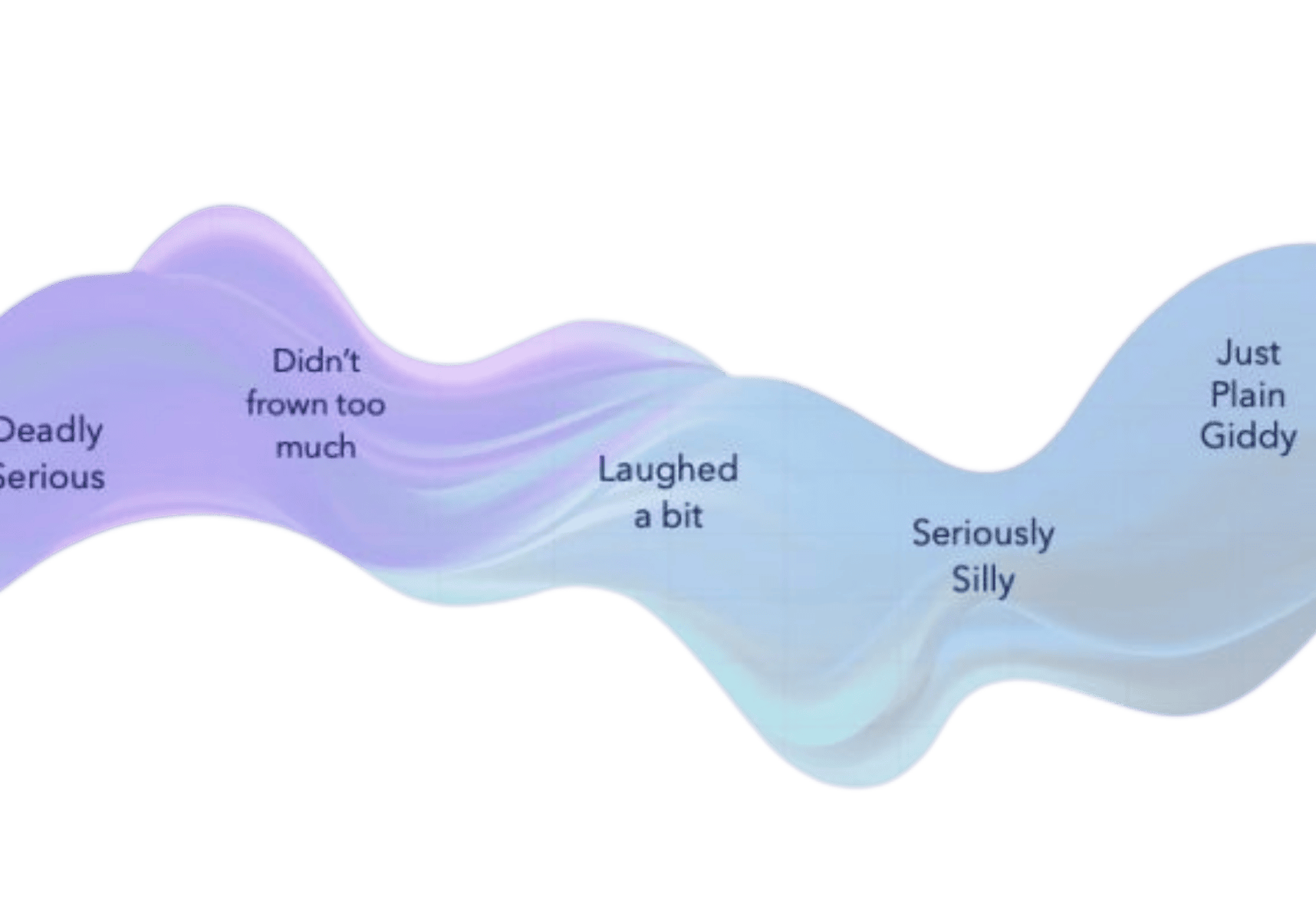
Let’s put everyday life on a continuum, from “Deadly Serious” on the left, to “Just Plain Giddy” on the right. How much time do you spend at the Deadly Serious end, and when was the last time you were Just Plain Giddy with joie de vivre?
In his Psychology Today article, Mark Travers Ph.D. recommends we have three types of hobbies – one each for keeping in shape, staying creative, and remaining sharp. But even with a hobby, there’s often emphasis to monetise it and make it pay, but that puts a lot of pressure on something that should feel light and immersive, done for its own sake. Not everything needs to be scaled up, sold on Etsy, or followed through with a BWYQ. It can just be.
Where are you these days?
Transactional Analysis describes three ‘ego states’ people can be in when we communicate with and relate to each other. They are fluid, and we slip in and out of them unconsciously, dependent on different situations.
In each State there are different aspects of that ego. For example, the Parent might be nurturing, critical or understanding. Think of how you behave with a partner who’s had a bad day at work. How do you respond?
The Adult State is logical, a problem solver and an effective communicator.
A Child might be adaptive (behaviour that makes us conform and fit in with the crowd), fearful, rebellious, or fun.
We’re looking for your fun Child to make an appearance.
Parents sometimes say their children permit them to be childlike again. When he does zoomies round the garden, my dog reminds me that I can have fun and when I’m crafting, writing or walking, I’m in the zone, enjoying myself.
What will take you from Serious Adulting to just Adulting? And then how do you get a little further to the right, towards your playful inner child?
The podcaster I mentioned earlier runs improvisation classes in Leeds, UK. He suggests these workshops help people step out of themselves and their lives into something lighter. Their inner child gets invited out to play.
If improv is too much -
- What about playing make-believe?
- Use silly voices?
- Finger painting?
- Make a blanket fort?
- Hopscotch?
- Hide and seek?
- Sardines?
- Simon Says?
- Anything playful you liked to do as a child?
What happens if we stay at the Serious Adult end of the spectrum for too long?
Humans aren’t designed to be serious all the time. Sometimes silliness can deliver something even a regular yoga, meditation or mindfulness practice can’t. I wonder what we have to lose if we adopt a silliness practice. The podcaster says he finds the more fun improv he does, the more the Just Plain Giddy end of the spectrum pulls him away from the Serious Adult in everyday life. It balances his life somewhere near the middle and that makes life richer, more engaging, more meaningful.
Perhaps if we can better recognise our different ego states, we can better integrate them into the everyday. If we invest in a silliness practice, it will help us find our Child State more often, and we can play tunes on the ratios of Serious and Giddy in our lives.
And if we can do both those things, we can improve our communication, our wellbeing and our lives.

Elspeth Raisbeck
Health and wellness writer after a career in nursing. I blend health science with personal growth, creativity, and everyday wellness.