
The Yoga Lab
The founding of a living yoga ‘laboratory’ designed to empower personal transformation and freedom in all that enter. By Jeremy David Engels
Yoga studios are places where people come together to practice community — in fact, for many yogis I know, their studio is their most beloved community. Yogis choose to practice in a studio, rather than alone at home guided by a YouTube video or an app, to connect with a teacher and their fellow students. We want to learn, to practice, to be, and to breathe together, supporting each other and offering cheers and high-fives.
Yoga is a practice of accepting suffering and transforming it. But what do you do if it’s yoga itself that causes suffering? The same question can be asked for any practice that you love. I have heard countless stories of fellow yogis injured by the physical practice of yoga — and it happened to me, too.
One of the most shocking things I discovered in my academic research about yoga’s history is that while yoga in its most expansive, mystical, cosmic sense is ancient, the elaborate practice of physical postures (asana) common today is relatively young. Postural yoga bears the profound influence of teachers from the 1930s and 1940s who did not have the benefit of knowing all that physical therapists, exercise scientists, biologists, medical doctors and kinesiologists have taught us today (how to move the body well so that it grows stronger and will age with good health). The asana practice they created, and passed down to many of us, is rarely biomechanically sound and often potentially injurious.
Learning the hard way
I didn’t know this when I first started practicing yoga regularly at a small community studio in my college town in 2009. I learned the hard way when I experienced a series of increasingly severe injuries over a two-year period. I loved the atmosphere at that studio and I trusted that my teachers knew what they were doing. But every time I felt like I was getting stronger, I got hurt! My neck ached, my hamstrings raged and my lower back radiated with such pain it was hard to walk most mornings. Is this what yoga is supposed to feel like, I wondered? It can’t be, can it? It got so bad that at the close of one ‘advanced’ back-bending practice I could not get up off the ground after savasana, I was in so much pain. All I could do was lie on the floor silently sobbing to myself. Eventually the teacher turned the lights off and left, telling me to lock up when I was done.
I’ve talked with hundreds of yogis about this, and it’s clear that stories of yoga itself becoming a cause of suffering are much too common. Have you, dear friend, found yourself injured by the very practice that promises you health (whether it is yoga or some other practice)? Or are you perhaps a kindhearted, well-meaning yoga teacher who is doing your best but who has noticed that, by simply repeating what you’ve been taught by your teachers, you are causing your students (and perhaps yourself) suffering?
Sharing the pain
If any of these situations apply to you, please know that you are not alone. All of us suffer, and all of us want to be happy. The question is, what do you do now? Do you try to push through? Do you quit? Or do you change the circumstances that are causing you and others suffering? That’s what I did — and it’s what you can do, too.
The first step is to understand the situation, including what is causing you pain and how you might remedy that pain. So my wife Anna Sunderland Engels (who was also injured by asanas) and I sought out new knowledge, participating in a postural yoga-teacher training programme taught by a brilliant physical therapist, Lara Heimann, that emphasised anatomy and functional movement.
We also dedicated ourselves to learning about the characteristics of healthy communities, including shared, democratic leadership; clear, confidential forums for members to ask questions and raise concerns; and a foundational, unshakable commitment to ahimsa, non-harming.
The second step is to gather with others who are also suffering to determine what you are going to do about it. Life is marked by suffering, but sometimes the best things in life are born from suffering met mindfully, together. So we got together with dear friends who, like us, had also sought out new knowledge, and were committed to practicing mindfulness, functional movement, healthy community and ahimsa. We discussed what was possible — and what to do next. We were realistic, but we also let ourselves dream big.
Soon, an idea emerged, as ideas do when people gather to communicate about the things that matter most to them: What if we started a new yoga studio based on our values? A place where students are safer in all ways— emotionally, spiritually and physically.
“Yoga Lab is a laboratory where students take themselves, and their habits, as the objects of inquiry. Our goal is to empower everyone who crosses the threshold into our space to develop their own inner and outer freedom.”
Yoga Lab is born
As we talked to each other from the heart, meditated, laughed, cried, lent each other support, dreamed big dreams, while sharing Thai food family-style in our living room, suddenly it seemed possible (and to be honest, it seemed necessary). And so that’s what we did. Yoga Lab State College was born in 2016. And what a gift it has been. My back is no longer broken, and my spirit is healed too, by this blessed community we’ve built.
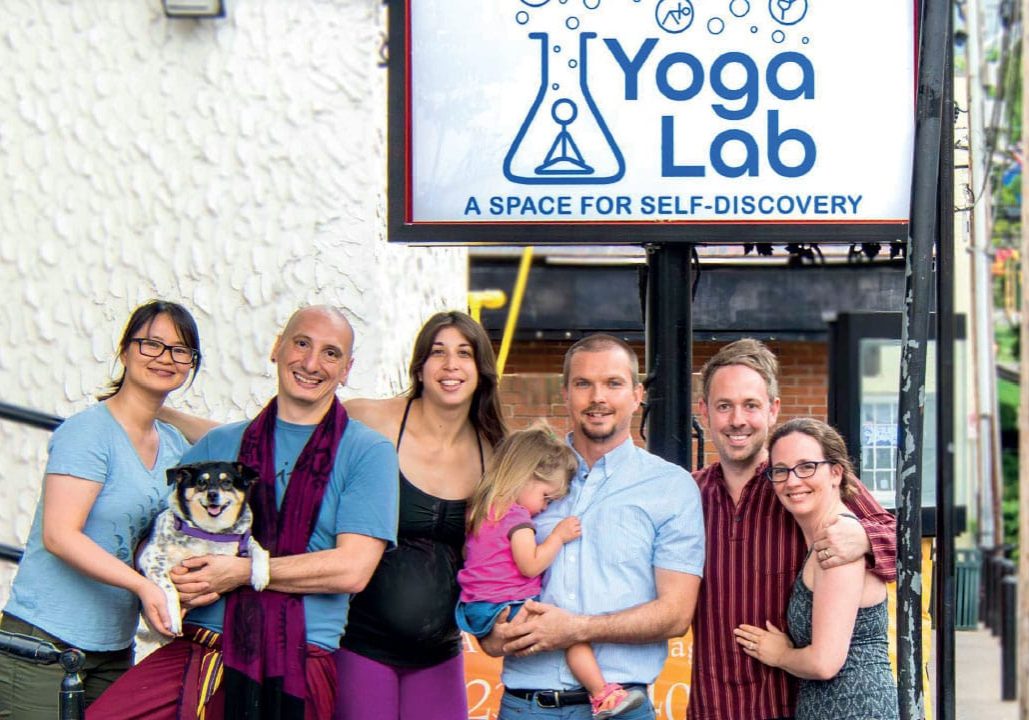
What makes Yoga Lab a beloved community? The founders— there are three of us who remain in town involved in the business and teaching at the studio, my wife Anna, our dear friend Kristen Boccumini, and me — are committed to a horizontal power structure with collaborative leadership. Yoga Lab is not a place run by one guru. Between the three of us, the owners bring in multiple sources of knowledge and expertise — including exercise science, biology, clinical psychology, neuroscience, history, ethics, rhetoric and philosophy.
We teach a postural practice that is informed by physical therapy, sound biomechanics and evidence-based research. We seek consent for all hands-on assists, and do not perform forceful adjustments that deepen range of motion. Our meditation practice is based on the extensive empirical research demonstrating the benefits of mindfulness.
We encourage questions and feedback from students and trainees (and we receive it!). We recognise the boundaries of our scope of practice, and make referrals when appropriate. We teach our yoga teacher-trainees how to be critical thinkers when engaging with yoga literature and resources, and do all that we can to encourage them to develop their own individual voices and talents in and outside the classroom.
“We teach a postural practice that is informed by physical therapy, sound biomechanics and evidence-based research. We seek consent for all hands-on assists, and do not perform forceful adjustments that deepen range of motion.”
Inclusive community
Recognising that a healthy community is inclusive, we’ve added a scholarship for our yoga teacher training programme to amplify the voices of underrepresented groups in our studio, and in our town. We are committed to sustainability: from the construction choices we made, to where we source our energy, and our charitable contributions. Yoga Lab is a diverse, welcoming community, where we remember the divinity in ourselves and each other, and where everyone is treated like the walking, talking miracles they are.
We call our studio a ‘place of self-discovery’ and that’s our vibe: Yoga Lab is a laboratory where students take themselves, and their habits, as the objects of inquiry. Our goal is to empower everyone who crosses the threshold into our space to develop their own inner and outer freedom.
Ultimately, we help each other to accept the suffering that must be accepted, but we are unwilling to acquiesce to injustice or spiritually bypass the wicked problems we share. We are committed to changing the world, in the sense of changing the causes and conditions that cause unnecessary suffering. We are committed to yoga as a collective practice of justice.
The suffering in ourselves, in the world, and in yoga spaces can seem overwhelming. But we should never underestimate the power of determined, mindful people working together as a community. Any time a student at Yoga Lab asks if changing the world is possible, I point to the sign on our door, and ask them: Do you know the story of how and why the founders of Yoga Lab created this studio?
Jeremy David Engels is co-founder of Yoga Lab (statecollegeyogalab.com) and the author of six books, including On Mindful Democracy: A Declaration of Interdependence to Mend a Fractured World (Parallax, 2026) and Living Namaste: A Practical Guide to Yoga, Mindfulness, and Building Community (Inner Traditions, 2026). Visit: jeremydavidengels.com
Find out more about Yoga Lab at: statecollegeyogalab.com

Om Magazine
First published in November 2009, OM Yoga magazine has become the most popular yoga title in the UK. Available from all major supermarkets, independents and newsstands across the UK. Also available on all digital platforms.