10 Mindful Movement Strategies Empowering Deaf Children Across the World
Karen Chekas describes her journey from Nepal to Ghana bringing the benefits of yoga to deaf children in some of the world’s poorest countries
My journey as a psychotherapist serving deaf students began at the American School for the Deaf. It was here that I discovered the power of healing practices for deaf children navigating complex trauma. This foresight enabled me to develop a therapeutic yet playful movement practice rooted in somatic principles. With the support of a UK overseas volunteer programme, I had the privilege of bringing my practice to deaf schools in Nepal in South Asia and Ghana in West Africa. I chose these two countries because, while Nepali Sign Language (NSL) and Ghanaian Sign Language (GSL) are distinct languages, both are influenced by American Sign Language (ASL). This shared influence created accessibility and opened a pathway for teaching my wellness practices in unfamiliar cultural landscapes.
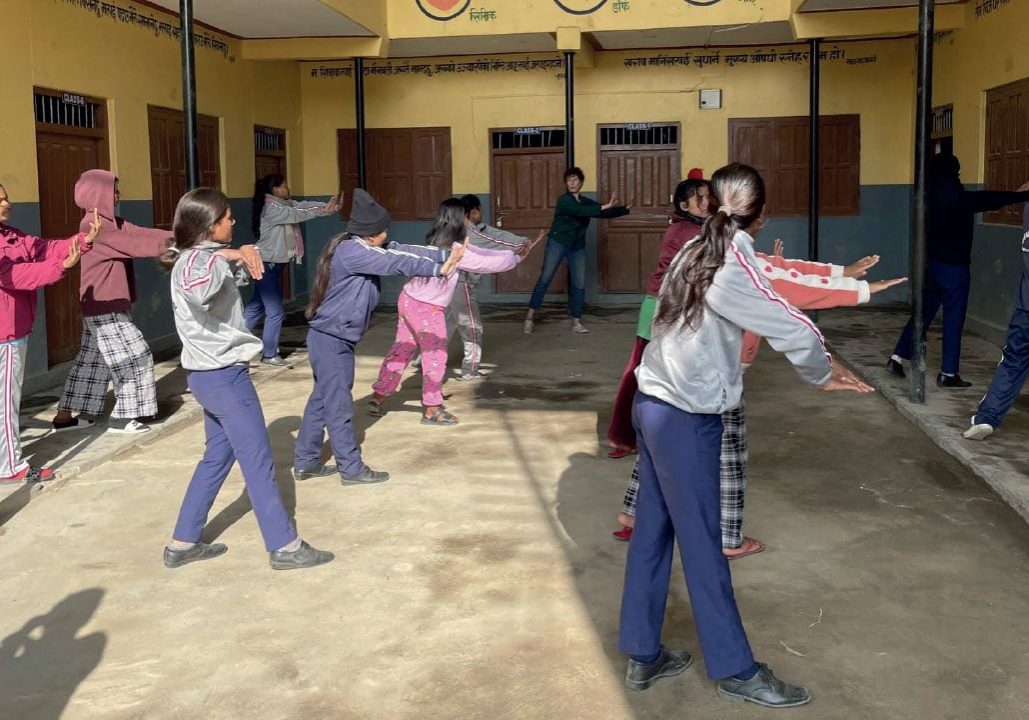
While overseas, I had two primary goals. The first was to learn local signs in support of student engagement, and the second was to teach my therapeutic movement practice. Instruction focused on the fundamentals of mindfulness for relaxation and self-regulation, utilising visual breathwork strategies, adapted Tai Chi–Qigong movements, and yoga poses infused with trauma-informed principles.
My first international volunteer experience began at Shrijana Residential Secondary School for the Deaf in Pokhara, Nepal, a region known as the gateway to the Annapurna Himalayan Mountains. Our travels were steeped in adventures as we hiked through the mountains alongside oxen, slept in tea houses, and absorbed the stillness of the peaks — an environment that naturally slowed the body and sharpened awareness.
Leaving the mountains of Nepal behind, I travelled to Ghana, where crossing suspension bridges, making fufu and witnessing ceremonial parades introduced a different rhythm of movement and connection. There, I volunteered at the Demonstration School for the Deaf and Cape Coast School for the Deaf and Blind, where place, presence and practice came together.
From these classrooms and communities, a set of movement strategies naturally took shape-adaptable practices that can be applied across educational and yoga settings. The following strategies emerged from this work and continue to guide my teaching with the deaf community.
1. Open Invitation
Invite students to choose whether to observe or participate in the class. For students who have never been exposed to yoga, a few minutes of observation can support processing, safety and a more grounded entry into the experience.
2. Line of Sight
Classroom space and size are often unknown when volunteering overseas. In classrooms for the deaf, establishing and maintaining clear sightlines between teacher and students is essential before introducing visual instruction. When a circular or open classroom layout isn’t possible, the presence of assistants helps preserve visual access, connection and a shared sense of ease.
3. Deaf-Inclusive Yoga Cues
A deaf-accessible yoga practice uses physical, tactile and visual cues to support body and spatial awareness. When learning environments are not fully accessible to deaf-inclusive cues, focus on what you can visually offer. Establish a shared vocabulary of signs, simple gestures and visual cues to create clear, consistent communication. Guide students with full-body demonstrated instructions, integrating shared vocabulary with expressive facial cues. Gentle rhythmic hand movements can illustrate inhalation and exhalation, while pointing to body parts or direction of movement helps students follow the flow. Incorporate yoga terminology sparingly, such as Warrior 1, while emphasising sensations like lengthening, release, or grounding. These combined visual cues, gestures, directional pointing, and full body demonstrations help students connect body awareness with mindful practice, even when resources are limited.
4. Class Introduction
When teaching international deaf students, their first questions often arrive with enthusiasm: What is your name? Where do you live? How did you get to our school? A brief introduction to include your teaching intentions, clearly communicated using simple gestures, helps establish a grounded and welcoming start to class.
5. Role-Model Breathwork
Begin class by role-modelling common school-based stressors and exploring how breath awareness supports mood regulation, enhances focus, and thoughtful decision-making skills. Students can quickly visualise this signed concept by comparing the experience of a racing heart versus a calm one, allowing attention to naturally turn inward.
6. Visually Engaging Breathwork
The learning environment guides how breathwork is introduced. Whether students are seated or standing, begin with a visual breathing pattern using rhythmic hand cues to support grounding and regulation. In seated positions, such as during Feeling Breath, or in outdoor and open spaces, Mountain Pose may be introduced, as both allow for easy modelling of alignment and hand-guided inhalation and exhalation. Allow children to learn through reflection by offering opportunities to compare two or three breathing patterns, pausing to notice which feels most supportive. This reflection process builds internal awareness and choice, while fostering emotional safety as students transition into a gentle flow.
7. Visually Led Movement
My movement practice is inspired by yoga, Tai Chi, and Qigong, using expressive hand formations that evoke action, geometric shapes, animals and elements of nature to support embodied awareness and sustained engagement. Movements progress from grounded, breath-led shapes into slow, circular or directional patterns, followed by brief pauses for reflection before transitioning into a gentle, continuous flow.
8. Empower Through Choice
Offer students a choice of breathing patterns, opportunities to notice body sensations and ways to explore empowering movements. This supports autonomy and emotional safety, especially for deaf children in residential schools.
9. Pause and Affirm
During or after key poses or movements, such as Self-Hug, Bow and Arrow or Wave Push, invite students to sign or visualise “I am” or self-love statements. Valence statements can be used in continuous patterned movements, and pausing fosters self-connection and reinforces affirmation.
10. Encourage Class Reflection
Conclude by inviting students to choose their favourite pose or movement, using it to build both a personal wellness routine and a shared classroom practice. Reflecting on my travels teaching across the world, one image stays with me: at the close of each class, students thanked me with the sign for “I love you”. This simple hand shape — symbolising love, affection, appreciation, or a heartfelt goodbye — reminds us that self-awareness and inclusion meet in the universal language of movement and connection.
For further information, and to see the therapeutic movement practices described in the article with corresponding images and instructions, please visit: karenjchekas.com/yoga

Om Magazine
First published in November 2009, OM Yoga magazine has become the most popular yoga title in the UK. Available from all major supermarkets, independents and newsstands across the UK. Also available on all digital platforms.