
A New Year, A Timeless Practice
Following the heart’s compass of sankalpa. By Kerry Cooper
“Why are you so enchanted by this world, when a mine of gold lies within you?”- Rumi
As the new year unfolds, many of us instinctively turn toward resolutions — lists of goals shaped by self-criticism, pressure and the belief that we must fix something about ourselves. And yet, despite our best intentions, these resolutions often slip away. Ancient yoga philosophy offers a kinder, more powerful alternative: sankalpa, a heartfelt intention aligned with our deepest truth.
A practice rooted in ancient wisdom
The word sankalpa comes from Sanskrit: san, meaning “connection with our highest truth,” and kalpa, meaning “a vow or commitment.” Far from being a simple goal, a sankalpa is a conscious, soulful resolve, an inner compass that guides us toward who we already are at our core. Unlike the disciplined path of Patanjali’s Yoga Sutras, sankalpa is rooted in the tantric traditions and is central to Yoga Nidra, where intention is planted gently in the fertile soil of a relaxed, receptive mind. This practice begins with a radical premise: you are already whole. Your sankalpa helps you remember your purpose and to move toward it with clarity.
Returning to the mat, returning to ourselves
Life pulls us in many directions: family needs, work pressures, health concerns, the emotional landscapes of those we love. It’s easy to lose our footing. Yoga offers a way back: steadiness in the body, a settling of the breath, a softening of the mind.
Each time we step onto the mat, we have the chance to reset. To seek balance again. To rediscover the quiet place within us that life’s noise often obscures. Our sankalpa becomes a thread we follow— one that helps us navigate the inevitable highs and lows of being human.
Why sankalpa matters
A sankalpa can support meaningful change: replacing unhelpful habits, shifting inner dialogue, nurturing resilience, and strengthening self-belief. It is not wishful thinking—it is practiced, repeated, embodied. Modern therapeutic approaches even draw on similar methods: replacing destructive thought patterns with supportive, empowering ones.
In Yoga Nidra, sankalpa is woven through the meditative journey, guiding the mind toward ease and alignment. Over time, this intention becomes a quiet force—subtle yet transformative.
Finding your sankalpa
If you are new to this practice, begin simply. Sit or lie down comfortably, fully supported. Let the breath become your anchor. The mind will wander, that’s natural, return gently to the breathing body, again and again.
With patience, an intention may arise—a phrase that feels true, steady, and encouraging. Sankalpa is always expressed in the present tense, as if it is already real:
“I am grounded.”
“I am strong.”
“I am at peace.”
When repeated with sincerity, a sankalpa becomes a seed planted deep within the subconscious, gradually shaping thought, behaviour, and experience.
So perhaps this year, instead of trying to change who we are, we soften our gaze and consider who we are becoming.
Sankalpa invites us to listen inwardly, to move with purpose, and to honour the gold that has always lived within.
Kerry Cooper is the chair of Yoga Scotland and brings decades of experience in education and community support to her role. Since qualifying with Yoga Scotland in 2014, she has shared yoga across diverse settings, including with people living with life-limiting conditions, reflecting her belief that yoga is for every body and every stage of life. Visit: yogascotland.org.uk

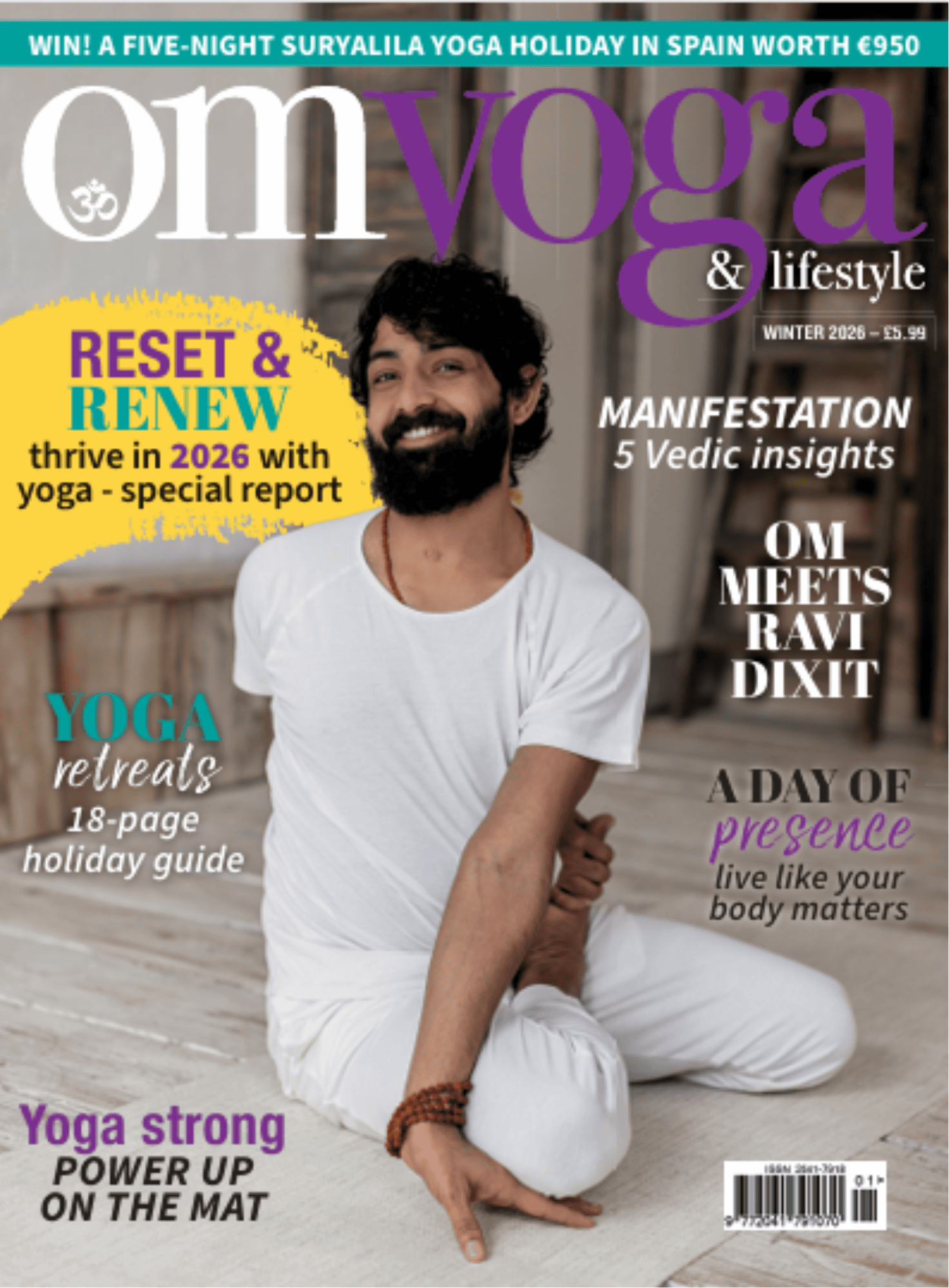
Om Magazine
First published in November 2009, OM Yoga magazine has become the most popular yoga title in the UK. Available from all major supermarkets, independents and newsstands across the UK. Also available on all digital platforms.